Development site valuation: how development land is valued
A development site valuation assesses the market value of land with development potential, based on what a developer could profitably build on it. The main method is the residual land value approach: it starts from the value of the finished development and subtracts all the development costs and the developer's profit, leaving the residual land value. This guide explains how a development site is valued, the residual land and direct comparison methods, and when you need a valuation.
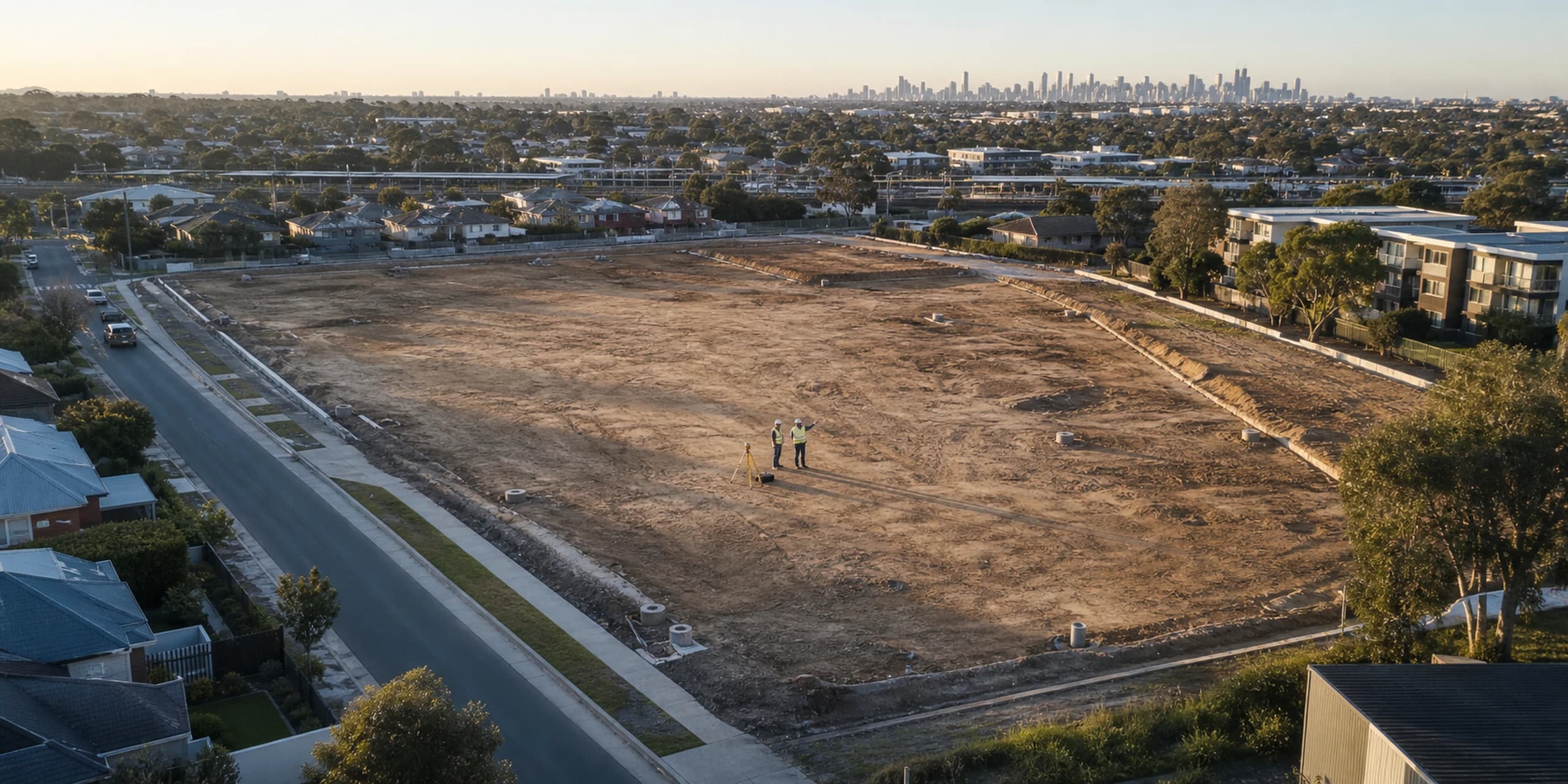
A development site valuation assesses the market value of land with development potential, based on what a developer could profitably build on it. The main method is the residual land value approach: it starts from the value of the finished development and subtracts all the development costs and the developer's profit, leaving the residual land value. This guide explains how a development site is valued, the residual land and direct comparison methods, and when you need a valuation.
Development land is not valued like an ordinary house. Its value comes from its potential, not its current use.
Key takeaways
- A development site valuation values land on its development potential, not just its existing use.
- The main method is the residual land value approach, working backwards from the finished project.
- Residual land value equals the completed value, less total development costs, less the developer's profit.
- Direct comparison against comparable sales of similar sites is used as a cross-check.
- The valuation rests on assumptions about the development, so those assumptions must be sound.
What is a development site valuation?
A development site valuation determines the market value of a site that can be developed, such as land suitable for a residential development or a mixed-use project.
Its value is driven by what can be built on it and sold, so the valuation is really a question about the site's potential.
That makes it more involved than a standard valuation. The valuer has to model a proposed development, not just compare recent sales.
Any existing improvements on the site, such as an old dwelling, are usually treated as having little value, or even a cost to demolish, because the value lies in what can be built. A formal valuation captures all of this in a single figure.
Highest and best use
The starting point is the property's highest and best use. This is the most valuable use that is physically possible, legally permitted and financially feasible.
A site might be worth far more as townhouses than as a single house, if the planning rules allow it. The valuation reflects that highest and best use, within what the zoning permits.
Getting this right matters, because the wrong assumed use produces the wrong land value.
The residual land value method
The residual land value method, also called the hypothetical development method, is the main approach for development sites.
It works backwards. The valuer estimates the value of the completed development, then subtracts everything it costs to get there, and what a developer needs to make.
What is left is the residual land value: the most a developer could pay for the site and still hit their required profit.
How the residual calculation works
The calculation runs through several inputs.
First, the completed value: the gross realisation, or total sale value, of the finished development.
Then the total development costs are deducted. These include construction, professional and consultant fees, contingency, marketing and selling costs, and finance and holding costs.
Developer's profit is also deducted, because no developer takes on the risk without a return, often expressed as a required profit margin.
The result is the residual land value. In short, completed value, less total development costs, less profit, equals what the land is worth.
As a simple example, if a completed project would sell for a gross realisation of ten million dollars, and costs plus the developer's profit come to eight million, the residual land value is around two million. That is the most the site is worth to that development.
Why assumptions matter
The residual method is powerful but sensitive. Small changes in the assumptions can move the land value a long way.
The assumed construction cost per square metre, the end sale prices, the timeframe and the interest rate all feed in. A valuation is only as good as the assumptions behind it.
This is why detailed market research and realistic inputs are essential, not optimistic ones.
Direct comparison method
The other approach is direct comparison. Here the valuer looks at comparable sales of similar development sites that have recently sold.
Comparable sales evidence gives a market check on the residual figure. Where good sales exist, direct comparison is a strong cross-check.
In practice, valuers often use both methods together, using direct comparison to sense-test the residual land value.
Development feasibility and the valuation
A development site valuation is closely tied to feasibility. Development feasibilities model the same numbers a developer would run before committing.
The valuation tests whether the proposed development actually stacks up, and scenario modelling can show how the land value changes under different assumptions.
If the feasibility is weak, the residual land value is low, however attractive the site looks.
The role of analysis and advisory
Because so much rests on the numbers, a development site valuation involves genuine analysis, not a template. The valuer stress-tests the inputs and the proposed developments against the market.
For larger development projects, this shades into advisory work: helping a buyer or lender understand not just the land value, but the risks and returns of the investment. Good analysis turns a raw calculation into a decision you can act on.
What affects a development site's value?
Several factors move the number beyond the raw calculation.
Planning and zoning are the biggest. What you are allowed to build sets the ceiling on value.
Location and demand drive the end sale prices, and therefore the completed value. Construction costs and market conditions affect the cost side.
Planning risk matters too. A site that still needs a rezoning or approval is worth less than one with a scheme approved, because the buyer carries that risk.
Who prepares a development site valuation?
A development site valuation is prepared by a qualified valuer, ideally a certified practising valuer who is a member of the Australian Property Institute and works to international valuation standards.
Valuers often draw on quantity surveyors for the construction cost inputs, since accurate costs are central to the residual calculation.
That combination of valuation and cost expertise is what makes the figure defensible.
When you need a development site valuation
An independent valuation is needed at several points in a project.
Common purposes include a site acquisition, where you want to know the most you should pay, and arranging finance, where the lender needs mortgage security.
Others include a joint venture, financial reporting, tax, or a dispute. Investors weighing development projects as investments also commission independent valuations to sense-check a deal. In each case an independent figure, rather than the developer's own optimistic number, is what is relied on.
How Valato helps
Valato provides independent development site valuations across Australia, using both the residual land value and direct comparison methods, prepared by qualified valuers.
Each report sets out the land value, the assumptions behind it, and the evidence, so you can rely on it for acquisition, finance or reporting.
Whether you are buying a site or funding a project, you get a defensible figure rather than a hopeful one. Compare the valuation options or order a valuation to get started.
The bottom line
A development site valuation values land on its potential, using the residual land value method to work back from the finished development, less costs and the developer's profit, with direct comparison as a cross-check. Because it rests on assumptions about what can be built and sold, sound inputs and a realistic feasibility are everything. For an acquisition, finance or reporting, an independent development site valuation is the figure that holds up.
Frequently asked questions
How is a development site valued?
Mainly by the residual land value method, which works back from the completed development's value, subtracting total development costs and the developer's profit. Direct comparison against similar site sales is used as a cross-check.
What is residual land value?
The most a developer could pay for a site and still make their required profit. It equals the finished development's value, less all development costs, less the developer's profit margin.
Why do assumptions matter so much?
Because the residual method is sensitive. Small changes in construction costs, end sale prices, timing or interest rates can move the land value significantly, so realistic inputs are essential.
What is highest and best use?
The most valuable use of a site that is physically possible, legally permitted and financially feasible. The valuation is based on this use, within what the zoning allows.
When do I need a development site valuation?
For a site acquisition, arranging finance or mortgage security, a joint venture, financial reporting, tax, or a dispute. An independent figure is what lenders and other parties rely on.
General information only: This article is general in nature and does not take into account your individual circumstances. It should not be relied on as tax, financial or legal advice. Speak with a qualified professional before making decisions about a development or investment.
Buying or funding a development site?
Independent development site valuations across Australia, using residual land value and comparison methods.
Order a valuationRelated articles.
How to prepare for a property valuation: Australian checklist
A practical Australian checklist covering documents, access, presentation, renovations and what happens when a valuer inspects your property.

Pre-sale (pre-listing) property valuation: should you get one?
A pre-sale valuation gives sellers an independent market value before listing, to set a realistic price, negotiate with evidence and decide with confidence.
Rural and agricultural property valuation
How rural and agricultural property is valued: methods, soil, water rights, carrying capacity and improvements, and when you need a specialist valuer.
Buying or funding a development site?
Independent development site valuations across Australia, using residual land value and comparison methods.
Buying or funding a development site?
Independent development site valuations across Australia, using residual land value and comparison methods.